
Cathodoluminescence

Home / Technology / Cathodoluminescence

Cathodoluminescence (CL) Imaging

Detect light emission from electron beam excitation to reveal defects, impurities, and material properties invisible to other techniques.

Cathodoluminescence Overview

Cathodoluminescence (CL) is the emission of light when a material is excited by an electron beam. This optical signal provides unique information about electronic structure, defects, trace element distribution, and growth history that cannot be obtained from conventional SEM imaging or even EDS analysis.

How Cathodoluminescence Works

When high-energy electrons from the SEM beam penetrate a sample, they excite electrons in the material to higher energy states. As these excited electrons relax back to their ground state, some materials emit photons in the ultraviolet, visible, or near-infrared range. The wavelength (color) and intensity of this emission depend on the material’s electronic band structure, defects, and impurities.

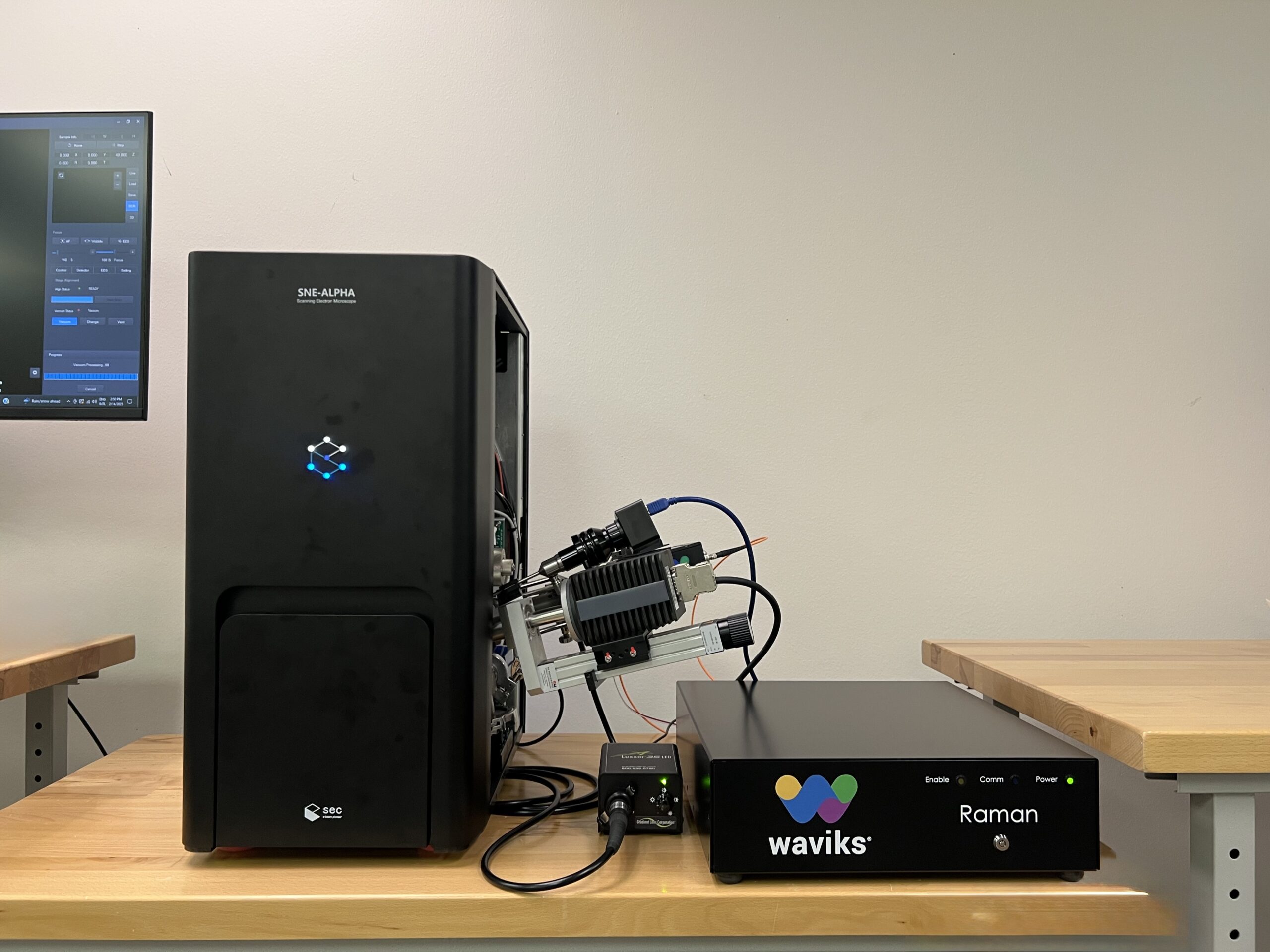
CL detectors collect this emitted light using a parabolic mirror or optical fiber positioned near the sample. The signal can be used to form images (panchromatic CL) or analyzed spectroscopically to determine emission wavelengths (hyperspectral CL).

CL Analysis Modes

Panchromatic Imaging

Collect all emitted light to create intensity maps. Reveals features like growth zoning, defect distributions, and compositional variations with high spatial resolution.

Color CL Imaging

Use RGB filters or color cameras to capture wavelength-dependent contrast. Different emission colors indicate different defect types or trace elements.

CL Spectroscopy

Measure the full emission spectrum at each point. Identify specific luminescence centers, quantify defect concentrations, and map spectral variations.

Hyperspectral Mapping

Acquire complete spectra at every pixel to create datacubes. Extract maps of specific emission peaks and analyze spectral shifts across the sample.

What CL Reveals

Defects and Dislocations

Crystal defects often create or quench luminescence. Threading dislocations in semiconductors appear as dark spots, while certain defect complexes produce characteristic emission peaks. CL is one of the most sensitive techniques for mapping defect distributions.

Trace Elements

Many trace elements at concentrations below EDS detection limits produce strong CL signals. For example, rare earth elements in minerals create distinctive emission colors, and nitrogen or silicon vacancies in diamond produce specific spectral signatures.

Growth Zoning

Variations in growth conditions leave luminescence signatures. CL reveals growth zones in minerals, semiconductors, and synthetic crystals that are invisible in SE or BSE images, providing insights into formation history.

Stress and Strain

Mechanical stress shifts emission peak positions. By mapping these spectral shifts, CL can visualize stress distributions around defects, interfaces, and mechanical damage.

Applications

Geology & Mineralogy

  • Provenance Studies: CL signatures help identify mineral sources and formation conditions
  • Diagenesis: Reveal cementation history and fluid flow in sedimentary rocks
  • Gem Identification: Distinguish natural from synthetic stones; detect treatments
  • Zircon Dating: Identify growth zones for precise U-Pb geochronology sampling

Semiconductors & Photonics

  • LED & Laser Quality: Map emission uniformity and identify killer defects
  • Solar Cells: Visualize grain boundary recombination and passivation quality
  • Quantum Dots: Characterize size distribution and emission properties

Ceramics & Phosphors

  • Phosphor Screens: Analyze emission efficiency and uniformity
  • Ceramic Processing: Study sintering, grain boundary phases, and porosity

CL vs Other Techniques

CL provides information complementary to other SEM analytical methods:

  • vs EDS: CL detects trace elements below EDS limits and reveals electronic properties, not just composition
  • vs EBSD: CL shows defects and optical properties; EBSD shows crystal orientation
  • vs BSE: CL reveals features invisible in atomic number contrast, like growth zones in chemically homogeneous materials

Sample Considerations

Not all materials exhibit cathodoluminescence. Metals and highly conductive materials typically do not luminesce. Best results come from:

  • Semiconductors (direct and indirect bandgap materials)
  • Minerals (especially silicates, carbonates, and phosphates)
  • Ceramics and glasses
  • Wide-bandgap materials (diamond, GaN, ZnO)

Recommended Equipment

Related Technology

Resources

Unlock Hidden Information with CL

Add cathodoluminescence capability to your desktop SEM for unique material insights.

Learn More

NanoImages Assistant

Online

Hi! I'm the NanoImages AI assistant. Ask me anything about our SNE-Alpha desktop SEM, applications, sample prep, or scheduling a demo.