
EBIC – Electron Beam Induced Current
A powerful way to look inside electronic materials.
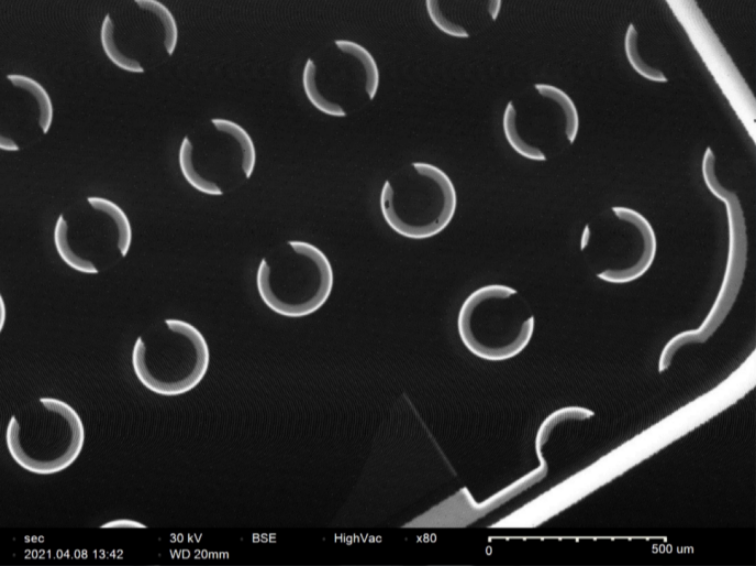
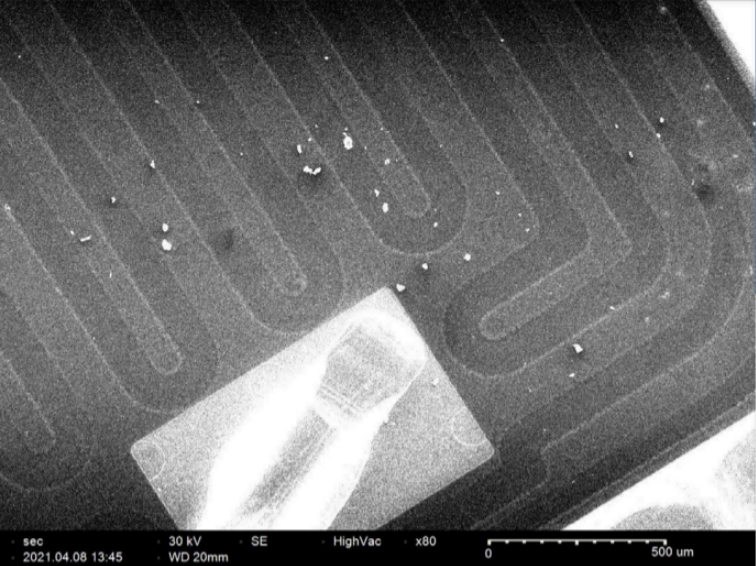
EBIC is a powerful analytical technique for examining the internal structures of electronic materials like semiconductors and LEDs. By detecting electrical currents induced when samples are exposed to the electron beam, EBIC reveals electronic properties and internal defects that are invisible to standard imaging techniques.
How EBIC Works
When an electron beam strikes a semiconductor material, it generates electron-hole pairs. In the presence of an electric field (such as at a p-n junction), these carriers are separated and collected, producing a measurable current. By scanning the beam and mapping the current at each point, EBIC creates images that reveal the electrical structure of the device—showing where carriers are generated, how efficiently they’re collected, and where defects disrupt normal behavior.
Applications
Semiconductor Devices
Visualize p-n junctions, depletion regions, and minority carrier diffusion in transistors, diodes, and integrated circuits. See the electrical structure overlaid on your SEM image.
Solar Cells & Photovoltaics
Map photovoltaic response across the cell, locate grain boundaries that affect efficiency, and identify recombination centers in crystalline and thin-film PV materials.
LEDs & Optoelectronics
Examine active regions, locate non-radiative defects, and correlate electrical activity with light emission for LED optimization and failure analysis.
Failure Analysis
Locate electrical defects, shorts, leakage paths, and junction anomalies in microelectronic devices with nanometer-scale precision—without destroying the sample.
Diffusion Length Measurement
Measure minority carrier diffusion lengths and lifetimes for semiconductor material quality assessment and process optimization.
Research & Development
Investigate new semiconductor materials, novel device structures, and emerging technologies with direct electrical characterization at the nanoscale.
Key Benefits
Non-Destructive
Analyze devices without damaging them. EBIC preserves sample integrity for further testing or correlation with other techniques.
Nanometer Resolution
Spatial resolution determined by the SEM beam size and carrier diffusion length—typically tens of nanometers for most semiconductors.
Correlative Imaging
Overlay EBIC data directly on SE or BSE images. Correlate electrical behavior with physical structure and morphology.
Unique Information
EBIC provides electrical property information unavailable from any other SEM technique—complementing EDS and imaging.
Applications
Materials Science
Metals, polymers, composites, failure analysis.
Life Sciences
Cells, tissues, biological structures.
Semiconductors
Wafer inspection, defect analysis, IC packaging.
Forensics
GSR analysis, trace evidence, fiber comparison.
Geosciences
Minerals, rocks, paleontology.
Nanomaterials
Nanoparticles, thin films, quantum dots.
Related Products
Resources
Characterize Semiconductor Devices
EBIC provides unique electrical information not available from any other SEM technique.
Discuss Your ApplicationOr call us: (925) 297-5668