
Quality assurance and quality control (QA/QC) are essential for reliable manufacturing and materials development. Whether the field is electronics, metallurgy, coatings, or medical devices, ensuring that every component meets defined standards is critical. Defects, contamination, or inconsistencies at the microscale can compromise performance, yield, and safety. Traditionally, high-resolution scanning electron microscopy (SEM) has been used to detect these issues — but the size, cost, and complexity of floor-standing SEMs have often limited accessibility.
Benchtop or tabletop SEMs provide an attractive alternative for quality management processes. They offer compactness without compromising on advanced analytical capabilities, making them practical solutions for QA/QC workflows. This blog post will outline how desktop SEMs can help technicians meet quality standards while offering insight into when you might choose the technology for your quality assurance process.
Traditional Tools vs. Benchtop SEM
Optical microscopy is fast and ubiquitous, but its ~200 nm diffraction limit makes it inadequate for tasks like resolving grain boundaries in thin films, identifying sub-micron contaminants, or characterizing nanostructured coatings. Users often end up inferring critical details indirectly—never a good fit for high-stakes QA processes.
Conventional floor-standing SEMs solve that problem with nanometer-scale resolution, multi-detector configurations (BSE, EDS, EBSD), and environmental chambers for non-conductive samples. But that capability comes with heavy trade-offs: vibration-isolated labs, water chillers, high-vacuum pumps, and operators with months of training just to run a basic session. For many companies, the instrument sits in a shared facility, creating scheduling bottlenecks that slow down R&D or production troubleshooting.
Benchtop SEMs close this gap by delivering 10–20 nm class resolution—sufficient for most failure analysis, particle inspection, and surface morphology studies—while drastically reducing the infrastructure burden. No dedicated HVAC, no separate utilities, minimal sample prep, and interfaces designed so QC technicians (not just PhDs) can run them. Many modern systems integrate EDS directly, allowing on-the-spot compositional analysis instead of shipping samples off-site.
The result: labs needn’t settle for underpowered optical inspection or the logistical drag of outsourcing SEM work. Instead, they can generate actionable nanoscale insights at the point of need, tightening feedback loops between process, QC, and design teams.
Key Advantages of Benchtop SEM in QA/QC
Benchtop SEMs bring several clear benefits to routine inspection and analysis:
- Compact and versatile: Small footprint instruments integrate easily into existing QA/QC labs.
- Lower cost of entry and operation: Purchase prices, maintenance, and energy use are all lower than full-size SEMs.
- Faster turnaround: Having in-lab SEM access eliminates shipping samples to central facilities and reduces lead times from days to hours.
- Ease of use: Automated workflows and intuitive interfaces reduce the training burden, enabling more team members to generate reproducible results.
- Combined imaging and analysis: When paired with energy dispersive spectroscopy (EDS), benchtop SEMs can both image and identify elemental composition — essential for pinpointing contamination or verifying material consistency.
- Reduced sample prep: Some models, such as those with low-vacuum capability, accept a wider range of samples without extensive coating or preparation.
For QA/QC teams tasked with balancing throughput, accuracy, and cost, these features can significantly improve operational efficiency.
What Features Matter in a Benchtop SEM for QA/QC?
When evaluating compact SEMs, not every specification is equally critical. For most quality control workflows, the following features provide the greatest impact:
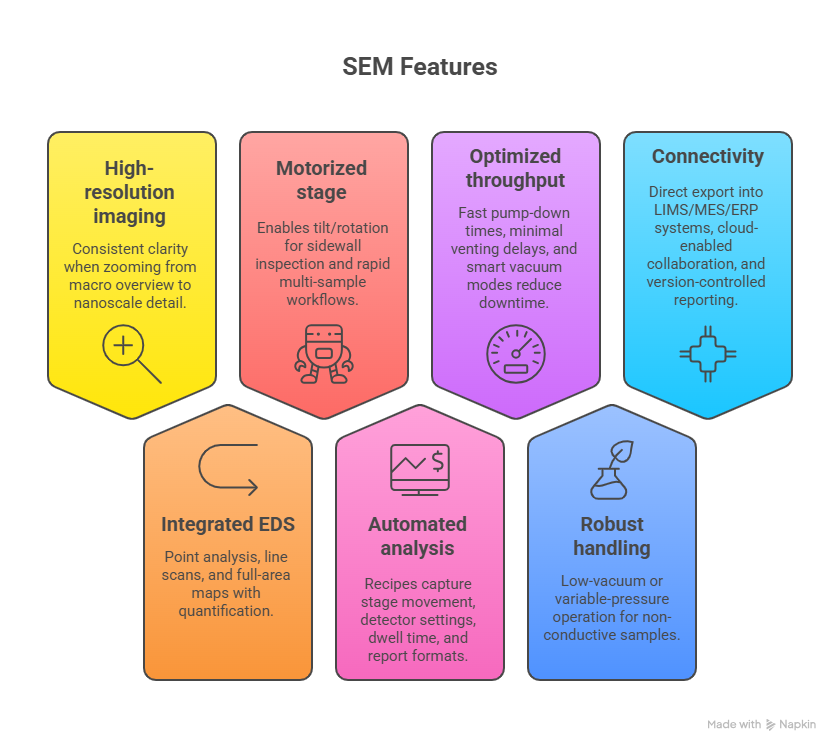
When is a Benchtop SEM Sufficient?
Benchtop SEMs are ideal when the features of interest are in the ~0.1–10 µm range—think inclusions in metals, voids in solder joints, cracks in coatings, or particulate contamination on wafers and medical devices. For QA/QC teams, the combination of 10–20 nm resolution and integrated EDS analysis is typically more than enough to verify material composition, confirm cleanliness, or spot early-stage process drift.
Turnaround time is another deciding factor. With sub-3 minute pump-downs, intuitive UI, and minimal sample prep (often no coating required thanks to low-vacuum modes), a benchtop system allows non-specialists to perform same-shift inspections—something impossible when samples must be queued at a centralized SEM facility.
Budget and space constraints also push the equation toward benchtop systems: no vibration isolation, chilled water, or separate SEM suite needed. Instead of six-figure infrastructure costs and dedicated operators, labs can deploy instruments directly on the production floor, embedding nanoscale insight into everyday QC workflows.
Full-size SEMs remain essential for ultra-high-resolution imaging (<1 nm), advanced multi-detector studies, and in-situ experiments that require variable temperature, strain, or environmental control. But the old assumption that EBSD requires a centralized, floor-standing instrument is no longer true. With the integration of QUANTAX ED-XS, benchtop SEMs can now perform EBSD analysis directly—unlocking crystallographic orientation mapping and phase identification in the same compact, accessible platform already used for routine inspection.
This means benchtop systems are no longer limited to morphology, contamination checks, or quick EDS scans. They can now address many of the same structural questions that once demanded outsourcing to a dedicated SEM facility. For production-oriented labs, the result is a higher return on investment: nanoscale imaging, compositional analysis, and crystallographic data generated at the point of need, without the delays and costs of scheduling time on a central instrument.
Learn More—Analytical Scanning Electron Microscopy (SEM): Principles, Techniques, and Applications
Interested in Improving YOur QA/QC Workflows with Benchtop SEM?
Benchtop SEMs have become essential for modern QA/QC workflows, bridging the gap between basic optical inspection and centralized SEM analysis. By combining accessible operation, fast turnaround, and advanced analytical capabilities, these instruments empower quality teams to detect defects earlier, confirm material consistency, and accelerate decision-making.NanoImages delivers these benefits with SEC’s SNE-Alpha tabletop SEM, equipped with Bruker QUANTAX ED-XS detectors for integrated imaging, EDS, and EBSD analysis. To learn how this solution can enhance your own QA/QC processes, contact NanoImages today to request a demo or arrange a sample evaluation.