
My dog brought the question home, lodged between his toes.
If you live anywhere in the dry-grass West, you know the drill: a summer walk, and a day later your dog is licking obsessively at one paw, or shaking his head, or sneezing in a way that doesn’t quit. The culprit is almost always a foxtail — a grass seed that went in easily and absolutely refuses to come back out. I’ve pulled them out of my dog’s paws and worked them out of his fur more than once, and every time I’ve had the same thought: what is it about the shape of this thing that makes it so good at getting in and so impossible to get out?
I happen to have a scanning electron microscope. So I pulled an awn, mounted it, and went looking for the answer between 200× and 10,000×.
What a “foxtail” actually is
“Foxtail” is a field name, not a botanical one. It covers the bristly seed heads of several grasses — wild barley (Hordeum), brome (Bromus), and their relatives — that share a particular dispersal trick. The unit that ends up in your dog isn’t really a “seed” in the casual sense; it’s a floret carrying a sharp, pointed callus at one end and a long, stiff bristle — the awn — trailing from the other.
The callus does the piercing. The awn does the rest. And the awn is where the SEM earns its keep, because the entire mechanism is too small to see with the naked eye.
The mechanism: a one-way ratchet
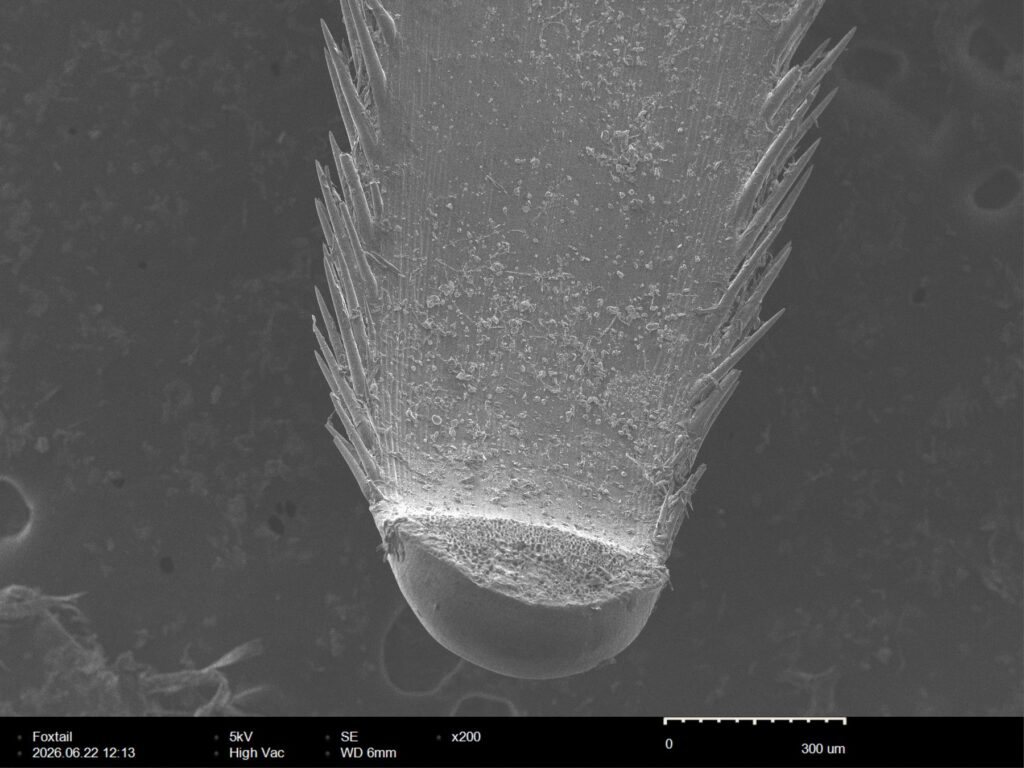
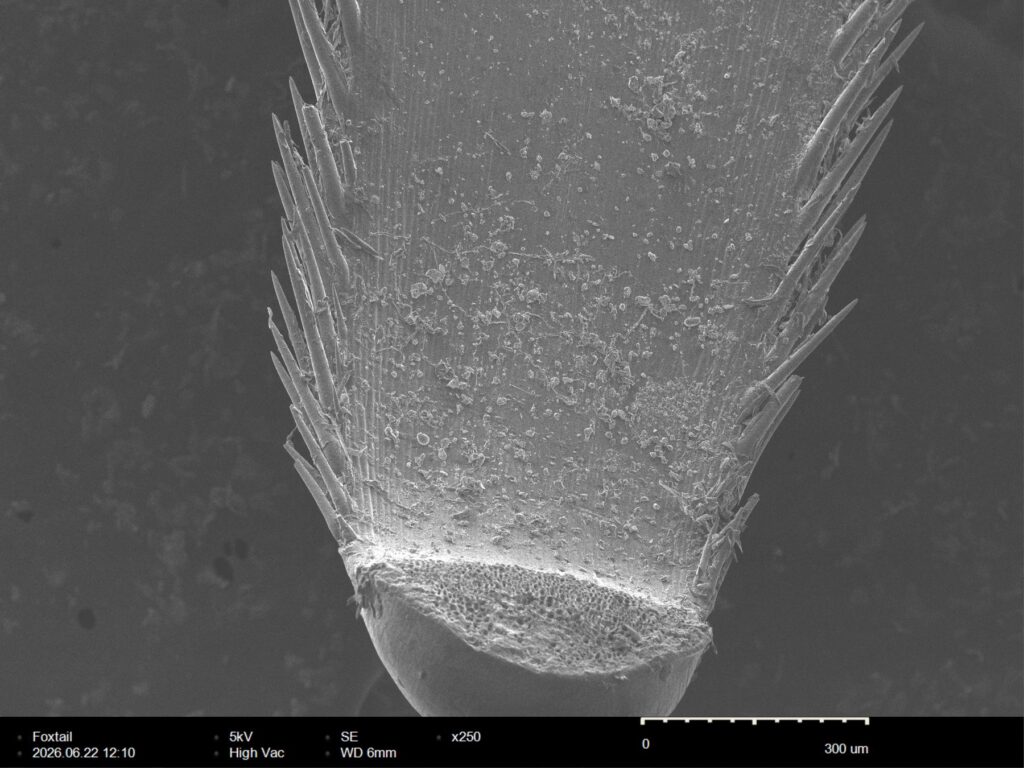
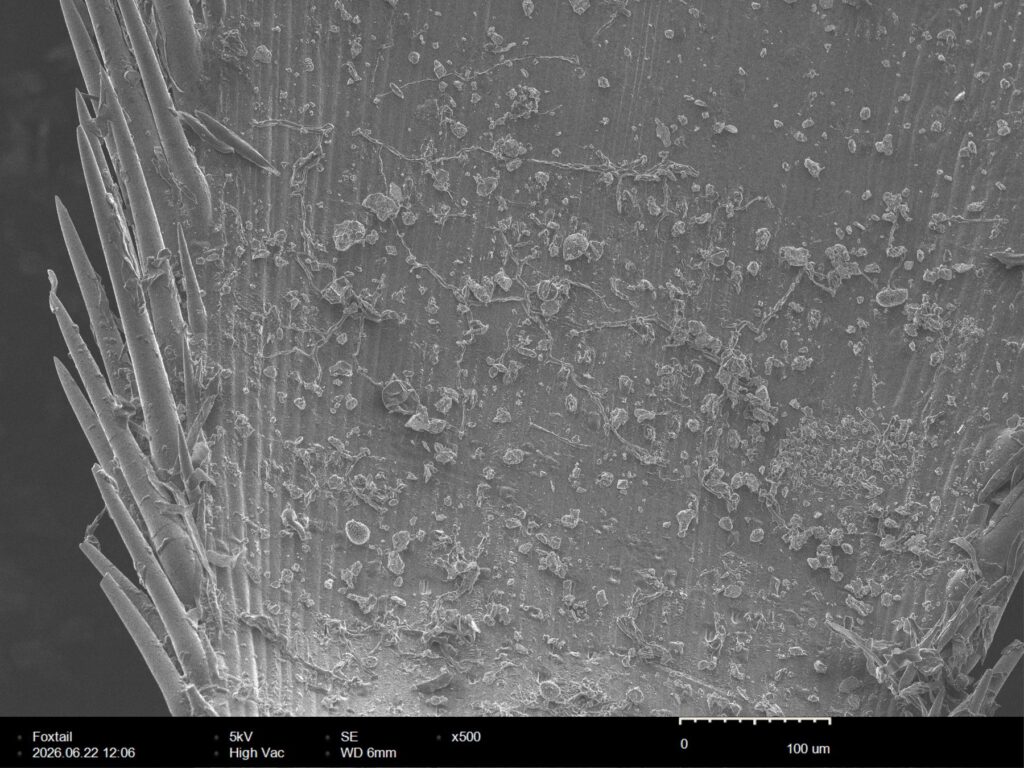
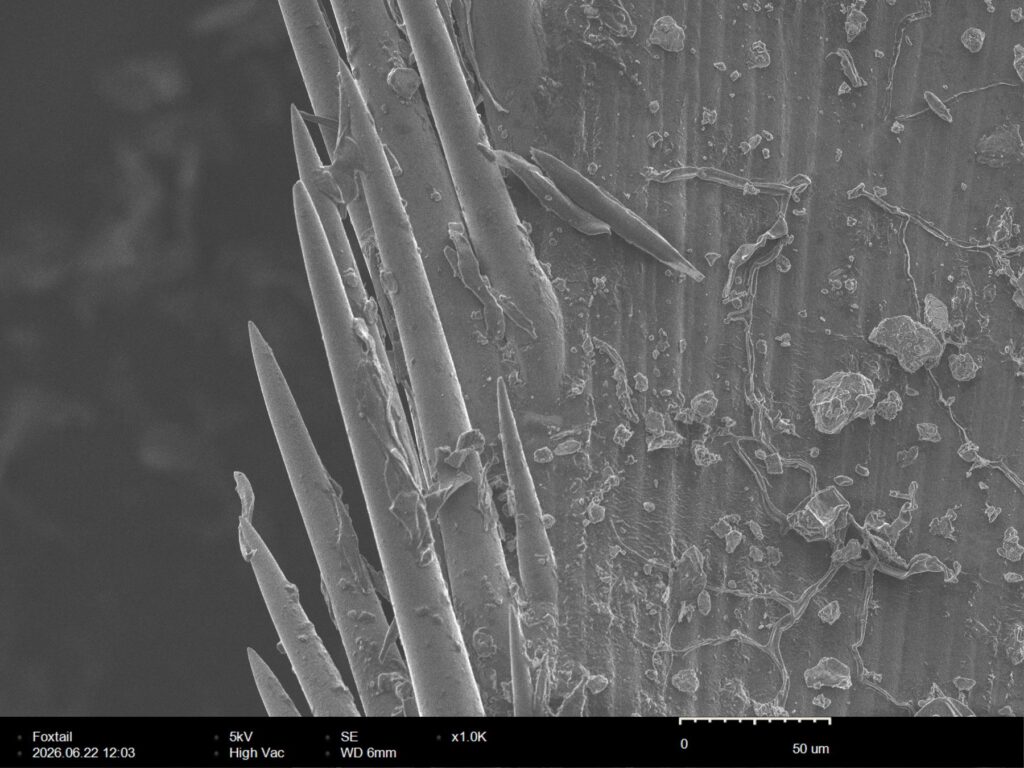
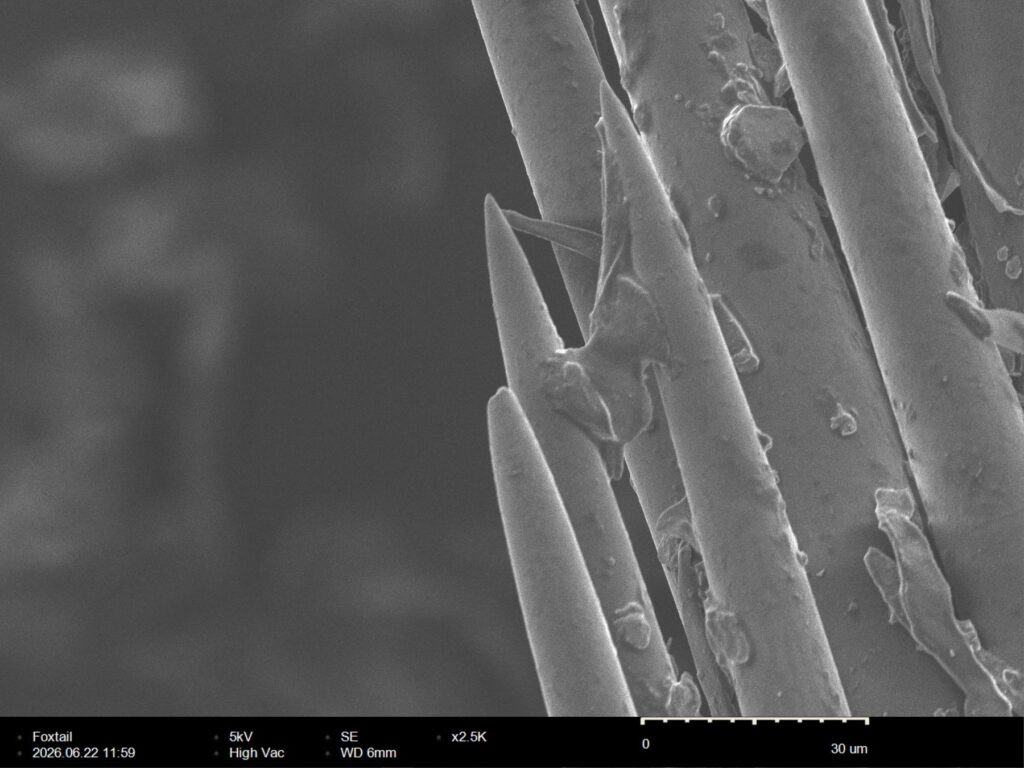
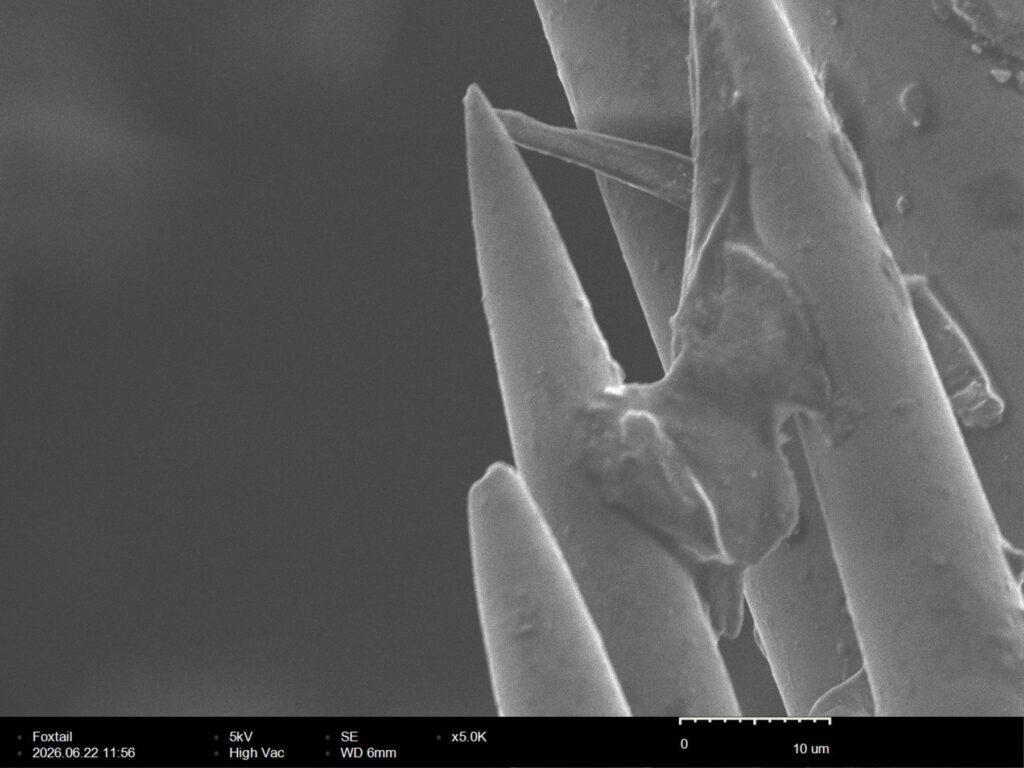
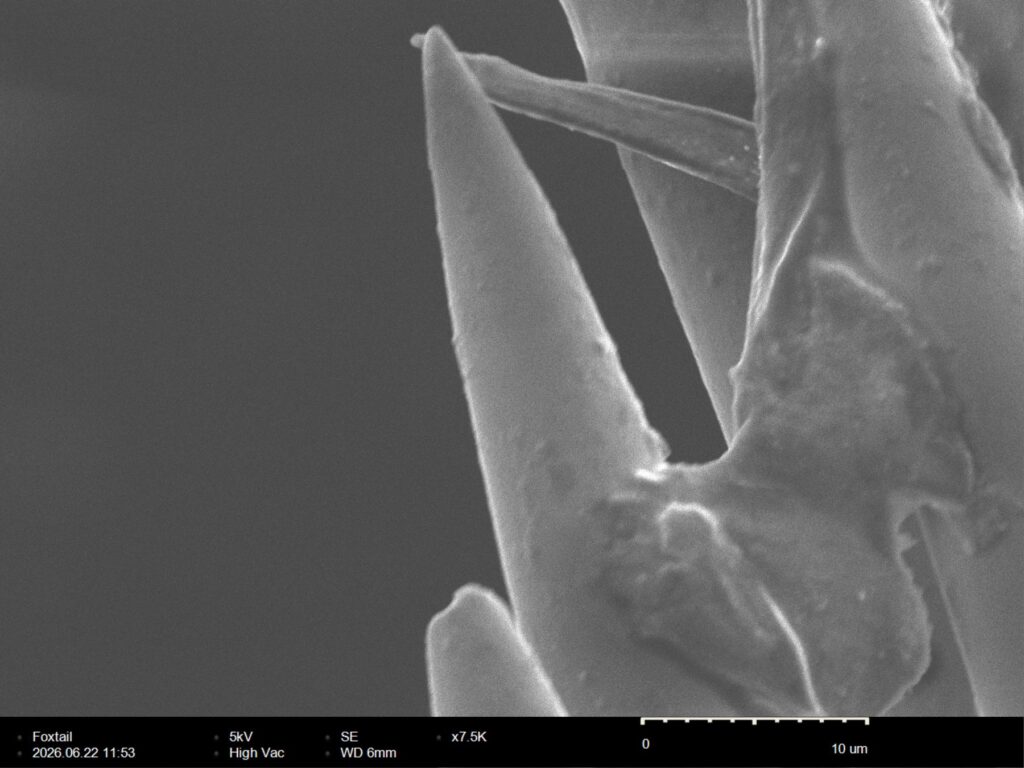
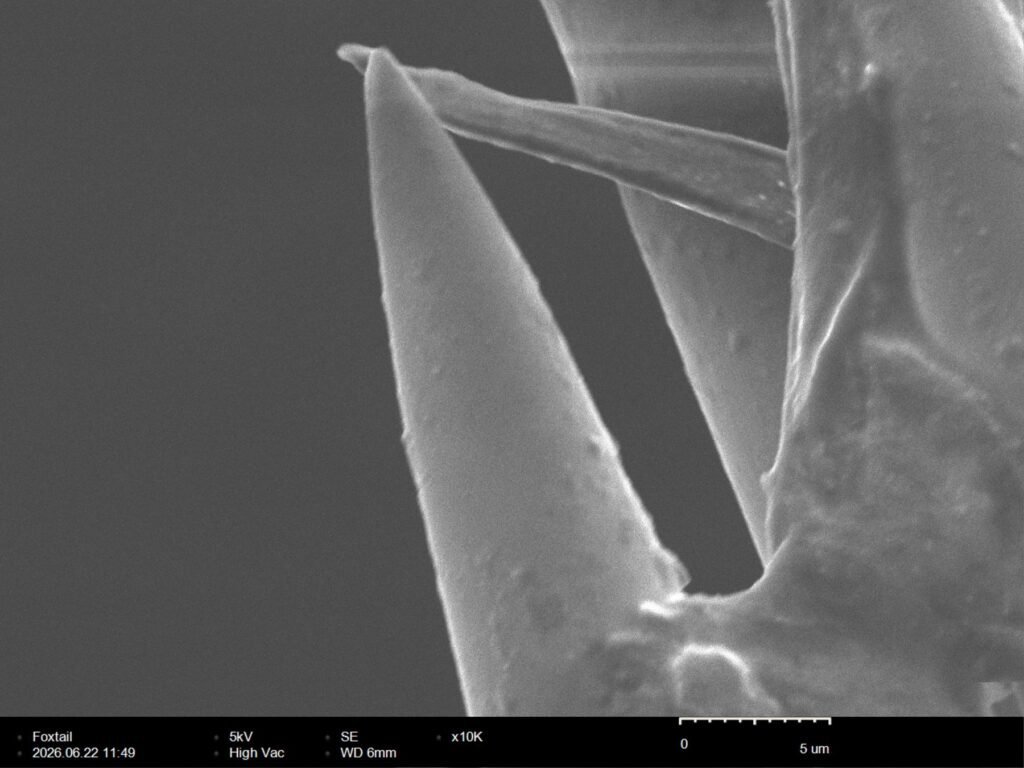
Run a foxtail awn between your fingers one way and it glides; the other way it catches and bites. Under the microscope the reason is obvious: the awn is lined with rows of stiff barbs that all rake in the same direction. That uniform rake turns the whole structure into a ratchet. The unit travels sharp-callus-first, and the backward-leaning barbs let it slide forward while gripping hard against any backward slip.
Any motion — a paw flexing, a muscle twitching, the awn itself bending as humidity rises and falls — gets rectified into travel in a single direction: deeper. The foxtail can advance, but it essentially cannot reverse. That’s why you can’t simply pull one out the way it came, and why an embedded awn can migrate through tissue — into interdigital spaces, ear canals, eyes, the nose, even inhaled into the lungs — instead of staying put. It’s an elegant piece of botanical engineering that happens to be a veterinary menace.
The SEM walkthrough
Acquisition: all eight frames at 5 kV, secondary-electron (SE) detector, high vacuum, WD 6 mm. The low accelerating voltage keeps the interaction volume shallow for crisp surface topography and is forgiving of charging on non-conductive plant tissue, while the SE signal gives the strong topographic contrast needed to read the three-dimensional relief of the barbs.
Why the structure matters in the clinic
Put the imaging together and the medical behavior stops being mysterious:
- It can’t back out. The backward-raked barbs catch on tissue during any retraction, so a foxtail only goes one way.
- It migrates. Combine a one-way ratchet with the constant micro-motion of a living body and the awn works itself steadily deeper — which is how foxtails turn up far from where they entered.
- It doesn’t dissolve. Silica-stiffened grass tissue is durable and slow to break down, so an embedded awn keeps acting as a foreign body — driving abscesses and infection — until it’s physically removed.
For owners, the practical takeaway is prevention and early detection: after walks through dry, seeding grass, check between the toes, inside the ears, around the eyes, and along the belly and armpits; watch for sudden obsessive licking, head-shaking, or relentless sneezing; and clear foxtail-producing grasses from the yard during seed season. Once an awn is in deep, it’s a job for your vet — not for tweezers.
A closing thought
Nothing about a foxtail is accidental. The backward barbs, the silica-hardened cuticle, the sharp callus — every feature is tuned by selection to do one thing: move a seed away from the parent plant and anchor it somewhere it can germinate. The fact that “somewhere” is sometimes your dog’s paw is just biology’s indifference to our preferences. But it’s hard to stay annoyed at something this beautifully built once you’ve seen it at 10,000×.